Category: Biz

  • How Life Insurance Settlements can help Individuals and Business Owners in a Market Downturn …

    How Life Insurance Settlements can help Individuals and Business Owners in a Market Downturn …

    Janice Gough

    For business owners and individuals who were caught off guard, without sufficient cash resources, the months ahead may be difficult as you adapt to the new reality of this unprecedented economic crisis.

    But perhaps, those hardest hit are retired seniors, whose nest eggs have lost a quarter of their value. Most people forget about life insurance as an asset. That’s why selling an unwanted life insurance policy, especially policies with escalating premiums or those on the verge of lapsing, is often a smart strategy for seniors who want to generate immediate cash flow.  I would never suggest replacing needed insurance protection, especially at this time in which our future is much in question. Many times, executives have left their company with portable life insurance with a high death benefit. They own a policy, in which the annual premium is a burden to their own cash flow. They may consider lapsing the policy because it has no cash surrender value, however, selling the policy in the secondary market for a substantial cash payment equivalent to nearly 30% of the policy’s face amount can aid in meeting one’s objectives. A financial broker using life settlements can increase one’s net worth substantially by selling the unwanted asset, many times, thought to have no value. With this kind of cash windfall, it is a great time to invest back into the market.

    During market downturns, having sufficient liquidity facilitates the ability to achieve a wide range of financial goals depending upon the senior’s net worth, emergency reserves, and cash flow objectives. Some “market savvy” seniors want extra cash to invest back into the market while stock values are low. They recognize an opportunity to leverage the financial crisis and need liquidity to seize it. Whereas, a senior who needs to rebuild their financial security may use unwanted life ins. As a source of cash to purchase a guaranteed income stream, such as investing in an income annuity. Their goal is to enjoy a comfortable retirement, free from the financial anxiety caused by market losses.  Other seniors who are cash depleted may want to shore up their emergency reserves to get through the crisis without making withdrawals from their investments. For them, money is not the only king, but cash flow is essential for long term survival. The scenarios listed may be readily achievable (for seniors who are over age 65 and who qualify) by selling an unwanted life insurance policy in the secondary market.

    Another consideration is to use the proceeds to purchase a Guaranteed Income Annuity.  Awareness of annuities as part of a comprehensive retirement strategy also gained traction recently when President Trump signed into law the SECURE Act. The new law makes it easier for employers to include annuities in their retirement plan investment options for company employees.

    Purchasing an annuity takes cash, which, for many, is scarce now. That’s where the proceeds from a life settlement can help. Many of our clients have been attracted to indexed income annuities because their monthly income can increase based on market performance, but that income will never decrease. By having a portion of retirement assets invested in income, annuities brings the best of both worlds.

    We are experiencing a financial crisis and need relevant sound solutions. And for senior clients who must rely on portfolio withdrawals for monthly cash flow, the ability to use the cash proceeds from a life settlement is undoubtedly a more prudent course of action than allowing clients to lock in losses. A correction is never the time to sell, your better option is to ride the market back up because once you sell your loss is locked in. There are many better options to take.

    Whatever your financial and liquidity challenges, maybe during the current economic crisis, now is the time to consider whether selling an unwanted life insurance policy is the most suitable option to generate cash flow.

    Janice Gough is a Financial Advisor. We are located in Palm Springs and can be reached by calling (760) 251-7724 or (650) 200-8291 or via email at Janice@GoughFinancialSvcs.com. Visit our website to sign up for our Financial newsletter, offering cutting edge information on ways to improve financial outcomes.


  • DESERT ARC HONORED

    DESERT ARC HONORED

    By Madeline Zuckerman

    Palm Desert, CA.  – Desert Arc, known for its outstanding work of enhancing the lives and creating opportunities for people with developmental and intellectual disabilities, was one of five recipients of the Riverside County Department of Waste Resources’ Sustainability Award on April 30th.  This annual Sustainability Award was established to distinguish the significant contributions of an organization’s efforts towards sustainability.  It is centered on the concept of recognizing innovative business practices that exemplify the 4 R’s: Reduce, Reuse, Recycle, and Rethink.  Every year the Board of Supervisors submits nominations from each of its five districts. 

                “We are celebrating our 60th Anniversary this year, and we are honored to receive this prestigious Sustainability Award,” stated Richard Balocco, President/CEO of Desert Arc.  “We are grateful to Supervisor Perez for nominating our Recycling Division, in recognition of our leadership role in the field of environmental stewardship program and serving people with disabilities,” Balocco continued.

    Back Row: Hans Kernkamp (Riverside County Dept. of Water Resources General Manager-Chief Engineer), Supervisor Kevin Jeffries, (First District), Supervisor Karen Spiegel (Second District), Supervisor Chuck Washington (Third District), Supervisor V. Manuel Perez (Fourth District). Second Row: Bonnie Woodrome, (EVMWD), and Clara Miramontes (City of Perris). First Row: Leah Di Bernardo (EAT Marktplace), Joanne Di Bernardo (EAT Marketplace), Christina Henry (EVMWD), Haley Munson (EVMWD), Isabel Carlos (City of Perris), Sabrina Chavez (City of Perris), Angelique Ontiveros (Desert Arc), and Frank Gonzales (Amazon Paint).

                Desert Arc’s Recycling Division, one of the five district winners selected for this prestigious Sustainability Award, was nominated by Riverside County Fourth District Supervisor V. Manuel Perez. Other distinguished honorees included Elsinore Valley Municipal Water District, Amazon Paint, Eat Marketplace in Old Town Temecula, and the City of Perris for its Live Well Perris Campaign and Grow Perris initiative.

                “Having toured Desert Arc’s Recycling Division, I have seen the hard work it does to recycle cardboard and electronics and keep these products from going to waste,” stated Riverside County Fourth District Supervisor V. Manuel Perez.  “The Recycling Center is driving environmental progress in the Coachella Valley and in our country.  For its leadership in sustainability, Desert Arc merits this recognition,” Perez continued.

                Commented Hans Kernkamp, General Manager-Chief Engineer of the Riverside County Department of Waste Resources, “these businesses and organizations are demonstrating a long-term commitment to creating healthier communities through sustainability and environmentally sound business practices.” 

                The end result of what Desert Arc achieves is clear: paper, cardboard, and electronics are being recycled instead of ending up in the landfill.  Whether it is picking up a big load of cardboard and inserting it into a baler, or diligently disassembling an old computer to uncover electrical components, there is always an opportunity to recycle.  Desert Arc fills a tractor trailer a week of both cardboard and shredded paper.

                “Desert Arc’s Recycling Division, headquartered in Indio, is thrilled to receive the Sustainability Award,” stated Angelique Ontiveros, Director of Business Services & Facilities for Desert Arc. “Our team works very hard each and every day to help make a difference in reducing waste and recycling resources in our local community.  It means a lot to all of us to be recognized among other innovative green business solutions in Riverside County,” Ontiveros continued.

  • U.S. Department of Transportation Highlights the Future

    U.S. Department of Transportation Highlights the Future

    THOUSAND PALMS, Calif. – The U.S. Department of Transportation’s Federal Transit Administration (FTA) Acting Administrator K. Jane Williams today joined SunLine Transit Agency officials and other local partners to highlight transit workforce training for innovative technologies of the future, including zero-emission transit buses.

    “Workforce development is a key priority for this Administration and the U.S. Department of Transportation,” said FTA Acting Administrator Williams. “The Administration’s economic policies have created unprecedented opportunities for American workers and American jobs, especially as technology continues to transform the employment landscape.”

    Williams joined officials at SunLine’s headquarters to highlight the agency’s efforts to improve workforce training and offer courses in the Fall of 2019.  They will focus on training current transit employees and providing them with skills that will support job retention for years to come.

    SunLine Transit Agency has been a leader in the public transportation industry by incorporating zero-emission buses and vehicles into its fleet, which now includes both hydrogen fuel cell and battery electric buses. These technologies are becoming more widely deployed throughout the transit industry as they can help lower operating costs and improve efficiencies in service.

    “The Federal Transit Administration is proud to partner with SunLine to help train the next generation of transit workers about the innovative technologies that are shaping the future of our industry,” said FTA Acting Administrator Williams.

    FTA has provided nearly $2 million in grant funding to help SunLine develop and demonstrate a comprehensive training program for the transit industry and to construct a state-of-the-art maintenance facility designed specifically for zero-emission buses.

    SunLine expects to begin construction on its West Coast Center of Excellence in Zero Emission Technology early next year. The center is a collaboration between numerous public and private organizations, including transit agencies, colleges, private industry, and government agencies that are involved in the development and maintenance of zero-emission buses.

  • Education Groups Call for Oversight of CA State Tax Credits

    Education Groups Call for Oversight of CA State Tax Credits

    SACRAMENTO, Calif. – Education groups are calling for more sunshine in the Golden State, with a bill that demands greater accountability for the billions of dollars of tax breaks California gives to commercial interests.

    Senate Bill 468 would sunset many business tax credits by 2023 and require that any extensions be justified with hard data. State legislative analysts would be directed to determine whether the tax credits are really bringing the benefits they promised.

    “The people of California give enormous tax breaks to a lot of corporations,” said state Sen. Hannah-Beth Jackson, D-Santa Barbara, who authored the bill, “and it’s to the detriment of our schools and to the detriment of other policies, like creating more affordable housing and working on wildfires.”

    SB 468, which has a hearing set for May 1, targets nine of the most generous tax breaks. One, known as the “Water’s Edge” credit, determines how multinational corporations pay their state taxes. Others subsidize airline fuel on international flights or give sales-tax exemptions for animal feed, farm machinery and custom software. Each tax break has its own supporters, many of whom say the state should be more-business friendly, not less.

    The California Department of Finance estimates that, from 2008 to 2021, tax incentives will have cost the state $500 billion. Dennis Meyers, assistant executive director for government relations for the California School Boards Association, said the analyses would provide lawmakers with the data to decide which tax breaks might have outlived their usefulness.

    “It could lead to $3 billion more a year, if all of these show that they’re not producing and not worthy of reinstatement,” he said. “That could lead to significant investment to move that needle in per-pupil funding.”

    Proposition 98 requires that schools automatically get more funding as the general fund grows. California ranks 44th in the nation in per-pupil spending, despite being the wealthiest state and the world’s fifth-largest economy.

    The text of SB 468 is online at leginfo.leglslature.ca.gov.

  • Don’t Forget to Plan for Pet-Care for the Long Term

    Don’t Forget to Plan for Pet-Care for the Long Term

    Janice Gough
    Janice Gough

    So many of us give our constant love and time to our pets; however, many forget to add their pets in their estate plan.

    Under our State laws, pets are considered personal property, and they need special consideration in an estate plan to ensure they receive the proper care when their owners can no longer care for them. A Pet Trust can dictate the type of care a pet will receive after its owner is gone and supply funds for that care; it also gives owners peace of mind knowing that their beloved pets will be cared for.

    By establishing a trust for your pets, you can plan for their care for their life after you can longer care for them. Even if you do have a specific person to care for your pet(s), setting up the Pet Trust is recommended in the event of the successor caretaker’s untimely death or health problems. 

    The pet trust will need to hold a certain sum of money to pay for the pet’s care. To determine the amount, first estimate the annual costs of food, veterinary care, routine medications, pet insurance, and supplements, as well as any other recurring fees, and then multiply that by the entire life expectancy of the pet(s). It is also essential to factor an extra amount, as your pet’s medical care costs may increase due to age.

    Be sure to identify each pet clearly.  To others, your pet may look like another. A specific description of the pet and its features is necessary, to ensure and avoid copycat pets. (Because there is money involved, an unscrupulous caretaker might seek to have payments continue past a pet’s death.). Include a list of microchip numbers and other identifying information in the trust document.

    Finally, the owner should clearly state in the trust that the care of the pet is the trust’s primary purpose and that all funds should be used to care for the pet. A remainder beneficiary can be listed for any funds remaining after pet’s death. Some chose a non-profit animal welfare group.

    In most cases, you will need to designate both a trustee and a caretaker. Consider these choices carefully. The trustee will be in charge of the money and will have the legal responsibility to ensure that the money is used correctly by the caretaker. You may also want to give the trustee the ability to remove and replace the caretaker, if necessary.

    The trustee is entitled to compensation, and it is generally a good idea to provide an annual stipend for the caretaker as well. Outline this compensation clearly in the trust. It is essential for you to list in detail how the pet should be cared for. Include the name of the preferred veterinarian and the minimum number of vet visits per year, as well as any requirements for boarding, grooming, pet walking services, toys, treats — even doggie daycare.

    Using these tips as a guideline for developing a pet trust will ensure that the pet is protected and well cared for.

    Janice Gough is a Financial Advisor in Palm Springs.  You may reach Janice  by calling (760)251-7724 or (650) 200-8291 or visit our website: www.GoughFinancialSvcs.com or Janice@GoughFinancialSvcs.com

  • KRISPY KREME RANCHO MIRAGE IS HERE!

    KRISPY KREME RANCHO MIRAGE IS HERE!

    OPENS TUESDAY 4/16/2019, DOORS OPEN 5:30 AM!

    Grand Opening today, the first 100 guests through the door will receive FREE doughnuts for one year and a t-shirt! So…the Very First guest through the door will receive a punch card for one free dozen Orignal Glazed doughnuts each week for one year. The next 99 guests will receive a punch card for one free dozen Original Glazed doughnuts each month for one year.

    KRISPY KREME RANCHO MIRAGE

    72787 Dinah Shore Dr. Rancho Mirage, CA. 92270

  • Coachella Valley residents ask to help Determine Health Care District Zones for 2020 Election

    Coachella Valley residents ask to help Determine Health Care District Zones for 2020 Election

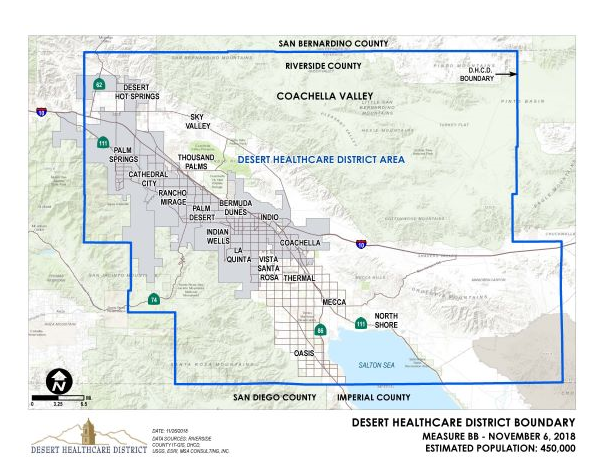
    The Desert Healthcare District is set to increase from five to seven zones before Election Day 2020, and the public is invited to contribute. The rezoning effort follows last year’s District expansion east of Cook Street and the appointment of two new Directors from the newly annexed area. When completed, there will be a zone for each of the seven seats on the Board of Directors.

    National Demographics Corporation (NDC) has drafted two seven-zone maps that will be presented during a public hearing at the District’s April 23 Board meeting. They will be a starting point for civic engagement; we want to hear from Coachella Valley residents. 

    Here are the preliminary map options:

    The NDC Agave map aims to create compact seats and follow major roads when necessary. It contains three of the seven zones entirely in the new annexation area. 

    The NDC Yucca map aims to create seats that link different communities together. It also contains three zones entirely in the new annexation area. 

    Read more of the maps’ descriptions and see them here.

    The public hearing on zoning will take place:

    5:30 p.m. Tuesday, April 23, 2019

    Fantasy Springs Casino Special Events Center — Hunal (Badger) Conference Room

    84245 Indio Springs Drive

    Indio, CA 92203

    Free Parking

    To RSVP, please contact Andrea S. Hayles at ahayles@dhcd.org. All other questions may be directed to Will Dean, director of communications and marketing, via email at wdean@dhcd.org.

  • SCAG Approves the Appointment of Kome Ajise as its Executive Director

    SCAG Approves the Appointment of Kome Ajise as its Executive Director

    LOS ANGELES – The Regional Council of the Southern California Association of Governments (SCAG) today approved the appointment of Kome Ajise as the organization’s new Executive Director.

    Ajise, who has served as Planning Director since November 2017, was selected to lead the nation’s largest metropolitan planning organization following an extensive search. He has 30 years of experience in regional planning and transportation, including serving as chief deputy director at the California Department of Transportation (Caltrans). Previously, he was Caltrans’ deputy director of planning and modal programs and was responsible for overseeing the Aeronautics, Mass Transportation, Rail, Transportation Planning, Local Assistance, and Research Innovation and System Information Divisions. 

    “Kome’s experience and his strong relationships at the local, state and federal level make him an ideal choice to lead SCAG into the future,” said SCAG President Alan D. Wapner. “This is a critical time for SCAG, as we work through our 2020 regional transportation plan, Connect SoCal, and provide our regional planning expertise to such important issues as reducing congestion, the housing crisis and attracting high-quality jobs to the region. Kome is a seasoned leader who understands the complex challenges we face in Southern California and throughout the state.”

    “It is an honor to have been tasked with this position. I want to thank Darin as it would not have been possible without his leadership. We have a lot of work to do, but we have an extraordinary team that has demonstrated, time and time again, its ability to tackle the kinds of planning and transportation challenges that come with a region as large and complex as ours. I look forward to working even more closely with everyone at SCAG, the 191 cities and the six counties we serve, at all levels,” Ajise said.

    He will assume his new role on an interim basis, effective immediately, pending the formal contract approval process.

  • Not a Blame Game: Women Demand Equal Pay and Equity

    Not a Blame Game: Women Demand Equal Pay and Equity

    Monday was April Fool’s Day, but an observance today is no joke to working women in Ohio and across the U.S. 

    April 2 marks Equal Pay Day, the date on the calendar representing how far into 2019 a woman has to work to earn the equivalent of a man’s wages in 2018. According to the Economic Policy Institute, women were paid almost 23 percent less than men in 2018, when accounting for race and ethnicity, education, age and location. 

    Kelley Griesmer, president and CEO of the Women’s Fund of Central Ohio, argued it will take squashing decades of implicit bias in society to close the gap.

    “This isn’t a blame game. It’s not about men setting out to really cause women some sort of pain, but it is all of this bias that has existed for years and years and years,” Griesmer said. “And there has to be an equity lens. The only way you get to true equality is through equity.”

    Griesmer explained that even if women started earning equal pay today, it would not cancel out the significant wealth gap that’s resulted from pay inequity over time. She believes a discussion is needed on how women can build wealth throughout their lives and become economically secure.

    Carolyn Casper, president of the Ohio Chapter of the National Organization for Women, noted racial disparities within the gender pay gap also need to be addressed. While women on average earn about 77 cents for every dollar a man earns, for black and Hispanic women it’s about 66 cents. And, Casper added, there are widespread implications.

    “This is not a women’s issue; this is a human rights issue,” Casper said. “This penalizes our families, it penalizes our community and it’s not an equitable way to treat workers. Our contributions over history have been very significant and they’ve yet to be recognized. “

    Casper is hopeful that policies such as the Paycheck Fairness Act will make a difference. The legislation, passed last week by the U.S. House, would ban employers from asking job applicants how much they previously made, forbid businesses from retaliating against workers who share wage information, and increase penalties for equal-pay violations.

    This story was produced in association with Media in the Public Interest and funded in part by the George Gund Foundation.